There’s little more evocative of France than the humble baguette.
Seeing someone stride home before breakfast with a still-warm baguette tucked under their arm is everyday life in France, where bread is central to nearly every meal.
British-style white-sliced loaves simply don’t compete.
Beyond tradition, the baguette is highly practical: crusty, versatile, portable and found on almost every French table.
Making baguettes at home is quite achievable, especially if you’ve baked loaves before. Some techniques differ and a light touch helps preserve the open crumb, but there’s no mystery. The only compromise is length — most home ovens can’t take a full-size baguette, so homemade loaves are usually shorter.
One further caveat: this recipe requires time.
Really.
It’s a two-day process, and the slow timetable is essential to developing flavour and structure.
The method is adapted from Peter Reinhart’s Artisan Breads Every Day and uses a cold-fermentation technique. The dough rests slowly overnight in the refrigerator, allowing flavour and texture to develop gradually so the finished bread is both taste-rich and wonderfully light.
It’s worth waiting for.
A stand mixer helps by cutting effort and mess, though the majority of the time is passive waiting.
Weigh 680g strong white flour, 14g salt, 7g instant yeast and 454ml lukewarm water into the mixer bowl. Mix on the lowest speed for a minute to bring the ingredients together using the paddle attachment. Switch to the dough hook and knead on medium-low for two minutes.
Tip the dough onto a lightly floured surface and knead by hand for about a minute to finish. The dough should be tacky but not overly wet or sticky.
You can do this entirely by hand if you prefer; the mixer simply makes it easier.
Transfer the dough to a lightly oiled bowl, cover with cling film and refrigerate overnight. The dough will keep in the fridge for up to four days, so baking can be scheduled flexibly.
When you’re ready to bake, handle the dough gently. Cold fermentation produces lots of gas and air pockets — these are what create the baguette’s characteristic open crumb.
Turn the dough onto a floured surface and divide it into four equal pieces.
To shape a baguette, pat a dough piece into a thick rectangle. Fold the bottom edge up to the centre and seal the seam with your fingers. Fold the top edge down over that seam, pressing to seal and creating a tight, drum-like surface. At this stage you have a batard, which can be left as is, but with a little more shaping it becomes a baguette.
Rest the formed batards for ten minutes, then repeat the folding. Finally, roll each piece back and forth with your hands, like a rolling pin, until it reaches the desired length.
Place each baguette on a lightly floured baking tray, cover with a floured tea towel and allow them to prove. From fridge to oven, allow at least two hours so the dough can fully awaken and rise; an hour and a half of proving is a common timing.
For a crisp crust you need high heat, so preheat the oven to its hottest setting well in advance — it can take 30 minutes or more to reach full temperature. Place a shallow tray on the bottom shelf to heat; this tray will be used to create steam.
When everything is ready, score each baguette diagonally three times to a depth of about 1.2cm (half an inch). Slide the trays into the oven, pour a cup of hot water into the heated tray on the oven floor to create an initial burst of steam, and close the door quickly.
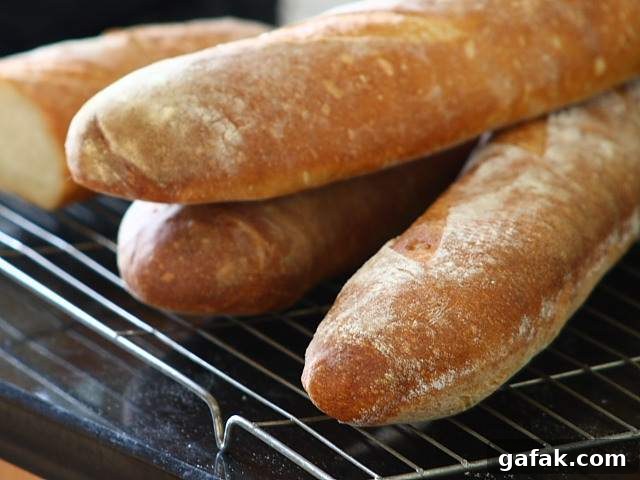
Reduce the oven to 230°C and bake for 12 minutes. Rotate the trays, lower the temperature to 200°C and bake for another 10–15 minutes, checking at the ten-minute mark. The baguettes should be golden brown, firm to the touch and sound hollow when tapped on the bottom.
Allow the loaves to cool on a wire rack for at least 45 minutes before slicing and serving.