




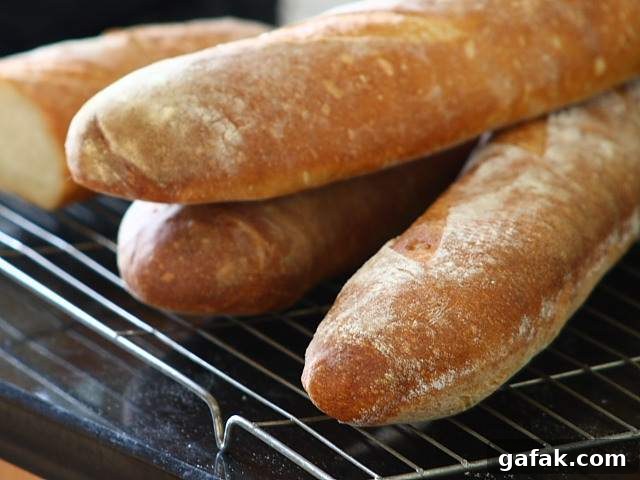
There’s little more evocative of France than the humble baguette.
Seeing someone stride home before breakfast with a still-warm baguette tucked under their arm is everyday life in France, where bread is central to nearly every meal.
British-style white-sliced loaves simply don’t compete.
Beyond tradition, the baguette is highly practical: crusty, versatile, portable and found on almost every French table.
Making baguettes at home is quite achievable, especially if you’ve baked loaves before. Some techniques differ and a light touch helps preserve the open crumb, but there’s no mystery. The only compromise is length — most home ovens can’t take a full-size baguette, so homemade loaves are usually shorter.
One further caveat: this recipe requires time.
Really.
It’s a two-day process, and the slow timetable is essential to developing flavour and structure.
The method is adapted from Peter Reinhart’s Artisan Breads Every Day and uses a cold-fermentation technique. The dough rests slowly overnight in the refrigerator, allowing flavour and texture to develop gradually so the finished bread is both taste-rich and wonderfully light.
It’s worth waiting for.
A stand mixer helps by cutting effort and mess, though the majority of the time is passive waiting.
Weigh 680g strong white flour, 14g salt, 7g instant yeast and 454ml lukewarm water into the mixer bowl. Mix on the lowest speed for a minute to bring the ingredients together using the paddle attachment. Switch to the dough hook and knead on medium-low for two minutes.
Tip the dough onto a lightly floured surface and knead by hand for about a minute to finish. The dough should be tacky but not overly wet or sticky.
You can do this entirely by hand if you prefer; the mixer simply makes it easier.
Transfer the dough to a lightly oiled bowl, cover with cling film and refrigerate overnight. The dough will keep in the fridge for up to four days, so baking can be scheduled flexibly.